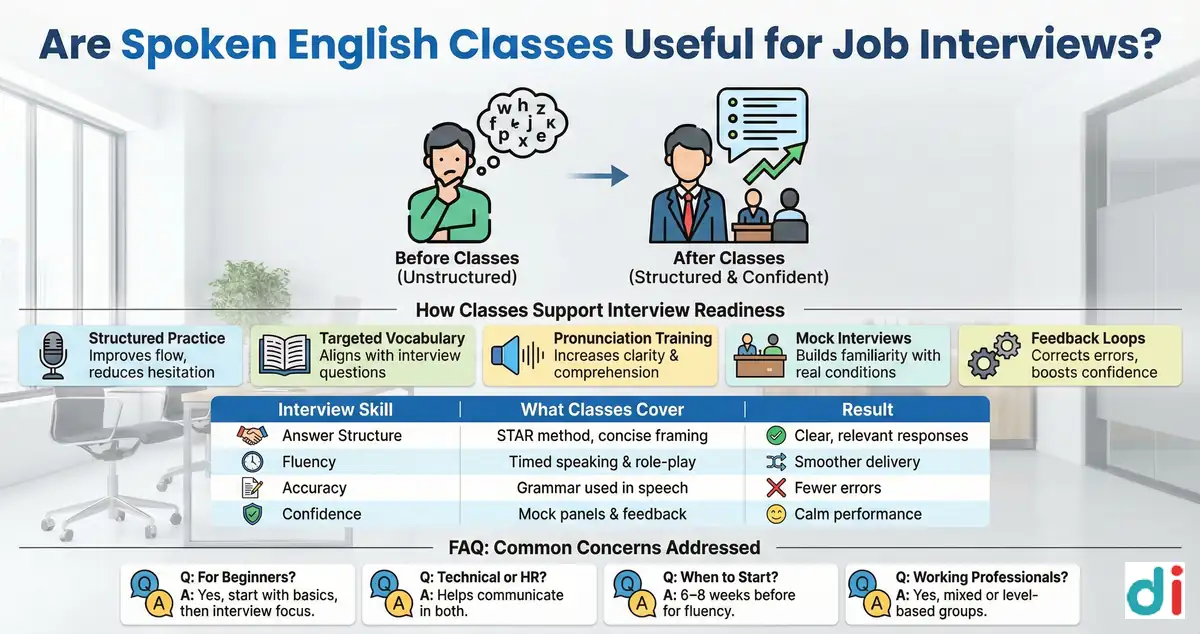
Spoken English Classes for Job Interviews
Spoken English classes for job interviews are not some fancy add-on anymore—they’re a survival skill in today’s hiring jungle. Talent alone doesn’t close the deal if your answers wobble, your thoughts scatter, or your confidence ghosts you mid-sentence. Recruiters don’t just listen to *what* you say; they judge *how* you say it. Within the first few minutes, fluency, clarity, and composure quietly shape their decision.
In the first round itself, spoken English becomes the filter. This is why many candidates now look at
spoken English classes for job interviews as targeted preparation, not general language learning. These programs focus on interview-specific speaking, helping adults express skills clearly under pressure, structure answers logically, and sound professional without sounding robotic.
How spoken English classes for job interviews improve hiring outcomes
Spoken English classes for job interviews work because they train the exact muscle interviews demand—real-time communication. Not theory. Not memorisation. Actual speaking.
These classes usually focus on:
- Answer framing using proven structures like STAR
- Interview-ready vocabulary commonly used in HR and managerial rounds
- Clear pronunciation for stronger listener understanding
- Tone control to sound confident without appearing aggressive or unsure
- Real mock interviews that simulate high-pressure situations
This is why
spoken English classes useful for job interviews consistently show better results than self-practice alone. You don’t just “know English”—you learn to *perform* it when it counts.
Why spoken English classes useful for job interviews focus on practice
Here’s the truth nobody likes to say: interviews are performance tests. You may know the answer, but if your delivery is scattered, the panel won’t wait patiently. Spoken English classes useful for job interviews train candidates to think and speak together—smoothly, calmly, and within time limits.
Practice sessions typically include:
- Timed responses to common interview questions
- Role-play practice for HR, technical, and panel interviews
- Real-time corrections delivered without breaking confidence
- Focused feedback on filler words, pauses, and body language
Over time, candidates stop translating in their head. Speech becomes automatic—and that’s where confidence quietly blooms.
What skills spoken English classes for job interviews actually build
Spoken English classes for job interviews don’t aim to turn you into a grammar book. They focus on outcomes employers notice instantly.
Key skills developed include:
- Logical flow and structure in spoken answers
- Use of professional sentence patterns
- Calm and composed responses during follow-up questions
- Clear explanation of technical knowledge in simple terms
- Improved listening skills and response accuracy
This is why spoken English classes useful for job interviews help both freshers and experienced professionals. Beginners gain foundation. Working professionals gain polish.
FAQs
Are spoken English classes for job interviews useful for beginners?
Yes. Spoken English classes for job interviews start with basic sentence formation and gradually introduce interview-style speaking, making them beginner-friendly.
How early should I join spoken English classes for job interviews?
Joining 6–8 weeks before interviews gives enough time to improve fluency, confidence, and answer structure.
Are spoken English classes useful for job interviews in technical roles?
Absolutely. They help candidates explain complex ideas clearly, which is critical in technical and managerial interviews.
Do spoken English classes for job interviews include mock interviews?
Most structured programs include mock HR and panel interviews to replicate real hiring conditions.
Is grammar taught in spoken English classes useful for job interviews?
Yes, but only in context—grammar is corrected during speaking so communication stays natural.