
Top costing classes for HS students in Benachity 2026
28 Jan 2026, 5:30 AM IST
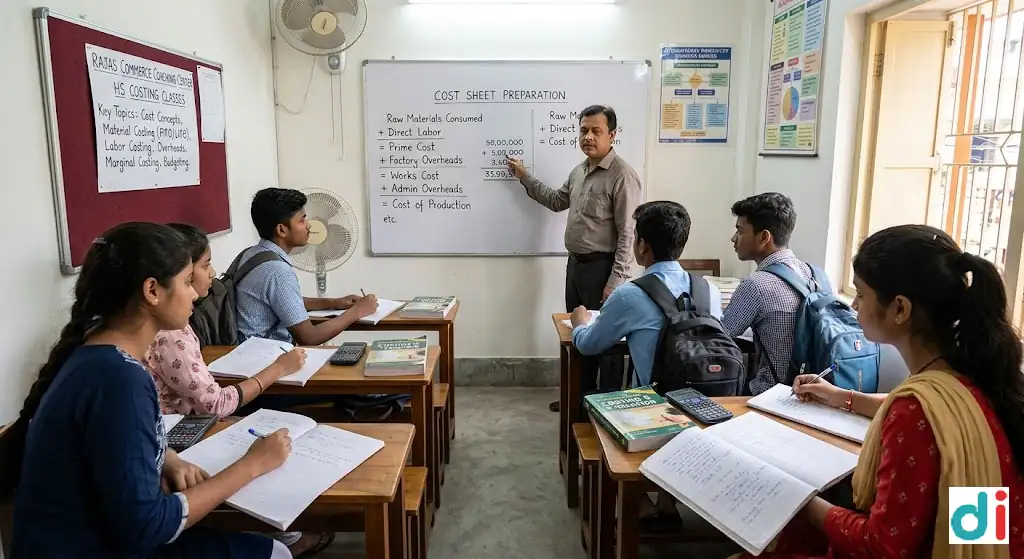
Costing classes for HS students Benachity build strong fundamentals in cost accounting, including material costing, labor analysis, and overhead management. Structured lessons simplify costing basics while improving exam readiness. Raja Commerce Coaching Center in South Ramkrishna Pally, Benachity, Durgapur offers focused guidance, practical examples, and concept clarity for higher secondary commerce students.A focused approach to costing helps HS students understand how businesses calculate, control, and reduce costs across operations, strengthening both academic performance and real-world understanding.
Let’s break down what makes structured costing learning truly effective.
What topics are covered in costing classes?
Costing classes cover essential areas such as cost concepts, material costing, labor costing, overhead allocation, cost sheet preparation, marginal costing, and budgeting. These topics help students understand how businesses calculate production costs and make financial decisions while also preparing effectively for HS commerce board exams.Costing Classes for HS Students Benachity – Building Strong Accounting Foundations
Choosing the right costing classes for HS students Benachity is not just about passing exams, it shapes how students understand business operations at a practical level. At Raja Commerce Coaching Center in South Ramkrishna Pally, Benachity, Durgapur, structured cost accounting tuition is designed to simplify complex topics into easy, relatable concepts. Many HS students struggle with costing basics because textbooks often feel abstract, but real-life examples change that instantly. Lessons begin with core definitions like cost, expense, and loss, then gradually move into classification of costs such as fixed, variable, and semi-variable. Once the base is clear, topics like material costing introduce inventory valuation methods including FIFO and LIFO, helping students connect theory with business situations. Labor costing follows, where wage calculation, incentives, and efficiency tracking are explained step by step, making it easier to solve numerical problems. Overhead costing becomes less confusing when students learn allocation and apportionment through simple case-based exercises. A major part of cost accounting tuition focuses on cost sheet preparation, which many students initially find intimidating, but guided practice turns it into a scoring area in exams. Marginal costing introduces decision-making techniques such as break-even analysis, which is not only exam-relevant but also highly practical. Budgeting concepts further enhance planning skills, helping students understand financial control. What sets structured costing classes for HS students Benachity apart is consistent revision, doubt clearing sessions, and exam-oriented practice. Instead of memorizing formulas, students learn the logic behind every calculation, which improves retention. Regular mock tests simulate board exam patterns, reducing anxiety and improving time management. Costing basics are reinforced repeatedly so that even average students gain confidence. Over time, accuracy improves, mistakes reduce, and problem-solving becomes faster. The environment also matters, and a focused classroom ensures minimal distraction and maximum engagement. For HS commerce students in Benachity, this approach bridges the gap between school learning and exam expectations. The result is not just better marks, but a deeper understanding of how costing works in real businesses. That clarity stays useful far beyond school exams, especially for students planning careers in commerce, accounting, or finance.Key Topics Covered in Accounts
| Topic Area | What Students Learn | Practical Benefit |
|---|---|---|
| Costing Basics | Cost concepts, classifications | Strong conceptual foundation |
| Material Costing | FIFO, LIFO, stock valuation | Inventory understanding |
| Labor Costing | Wage systems, efficiency tracking | Real-world wage calculation skills |
| Overhead Costing | Allocation and apportionment | Cost distribution clarity |
| Cost Sheet Preparation | Full cost structure of a product | High-scoring exam topic |
| Marginal Costing | Break-even analysis, decision making | Business decision insights |
| Budgeting | Financial planning and control | Better financial awareness |
Why Costing Classes Matter for HS Students
Strong Grip on Costing Basics
- Concepts become clear instead of memorized
- Numerical problems feel easier with practice
- Students gain confidence in exams
Better Performance Through Cost Accounting Tuition
- Regular tests improve accuracy
- Doubt-solving reduces confusion
- Structured learning boosts scores