Difference Between Bank Advisor and Bank Agent
13 Feb 2026, 10:24 PM IST
When people search for the difference between bank advisor and bank agent, they are usually confused about whom to trust with their money. This confusion is common in India, especially when loans, fixed deposits, insurance, or savings plans are involved. Understanding bank agent vs advisor roles helps customers avoid wrong decisions, hidden charges, and long-term financial regret.
Why this topic matters to everyday banking customers
Most customers don’t realise that advice and sales are two very different things in banking. One focuses on suitability. The other focuses on volume. Knowing the difference between bank advisor and bank agent protects your income, credit score, and future plans.What is the real difference between a bank advisor and a bank agent?
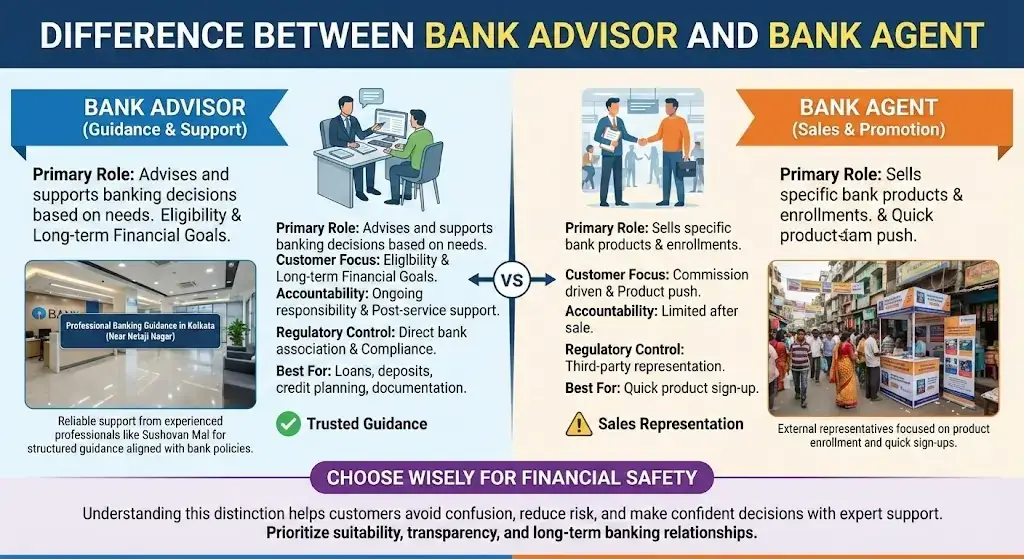
A bank advisor works inside or directly with a bank system and provides need-based guidance. A bank agent works as a product seller who earns commission per sale. This single distinction changes everything—from trust to accountability.Role clarity: advisory support vs product selling
What a bank advisor actually does
A bank advisor evaluates income, liabilities, credit history, and financial goals before suggesting a solution. The advice is structured, regulated, and long-term. When customers approach a bank advisor, they receive clarity on loans, deposits, savings, repayment strategy, and documentation.In real life, a bank advisor explains why a loan should or should not be taken now. Sometimes the best advice is to wait. That honesty defines the difference between bank advisor and bank agent.
What a bank agent focuses on
A bank agent’s role is limited to selling specific products such as insurance, credit cards, or accounts. The recommendation often depends on commission slabs. Once the product is sold, support usually stops.This is why the bank agent vs advisor comparison matters so much for first-time borrowers and senior citizens.
Authority, accountability, and trust
Accountability after the sale
A bank advisor remains answerable even after the product is issued. If a problem arises, follow-up support exists. A bank agent typically moves on to the next sale.This ongoing responsibility is a core element of the difference between bank advisor and bank agent.
Regulatory structure
Bank advisors follow internal banking policies, RBI norms, and compliance rules. Agents work under third-party agreements. This difference impacts customer safety.Local context: banking guidance that understands real lives
Customers living near Netaji Subhash Chandra Bose Rd, Shanti Nagar, Netaji Nagar, Kolkata, West Bengal often face mixed advice from multiple sources. As a professional bank manager, Sushovan Mal offers grounded guidance based on real income patterns, local employment realities, and family responsibilities.This is not scripted advice. It comes from years of dealing with real cases—missed EMIs, wrongly chosen insurance plans, and poorly timed loans. That experience reflects the true difference between bank advisor and bank agent.
Comparison Table: Bank Agent vs Advisor
| Basis of Comparison | Bank Advisor | Bank Agent |
|---|---|---|
| Core Objective | Customer financial suitability | Product sales |
| Income Model | Salary or fixed professional role | Commission-based |
| Advice Type | Need-based and regulated | Product-focused |
| Post-Sale Support | Ongoing assistance | Limited or none |
| Risk to Customer | Low | Medium to high |
| Best For | Loans, deposits, planning | Quick sign-ups |
When should you choose a bank advisor?
Choose a bank advisor when decisions involve long-term impact—home loans, fixed deposits, retirement savings, or restructuring debt. These decisions need planning, not pressure.The difference between bank advisor and bank agent becomes obvious when something goes wrong. Advisors stay. Agents disappear.
When does a bank agent make sense?
A bank agent may be useful for simple, low-risk products where guidance is minimal and urgency is high. Even then, customers should verify details independently.Practical takeaway for customers
If advice sounds rushed, commission-driven, or one-size-fits-all, pause. If advice considers your income, family needs, and future plans, you are likely dealing with an advisor. That awareness alone can save years of financial stress.Understanding the difference between bank advisor and bank agent is not about titles. It is about responsibility, intent, and trust.