Fixed Deposit Benefits Explained for Indians
13 Feb 2026, 10:24 PM IST
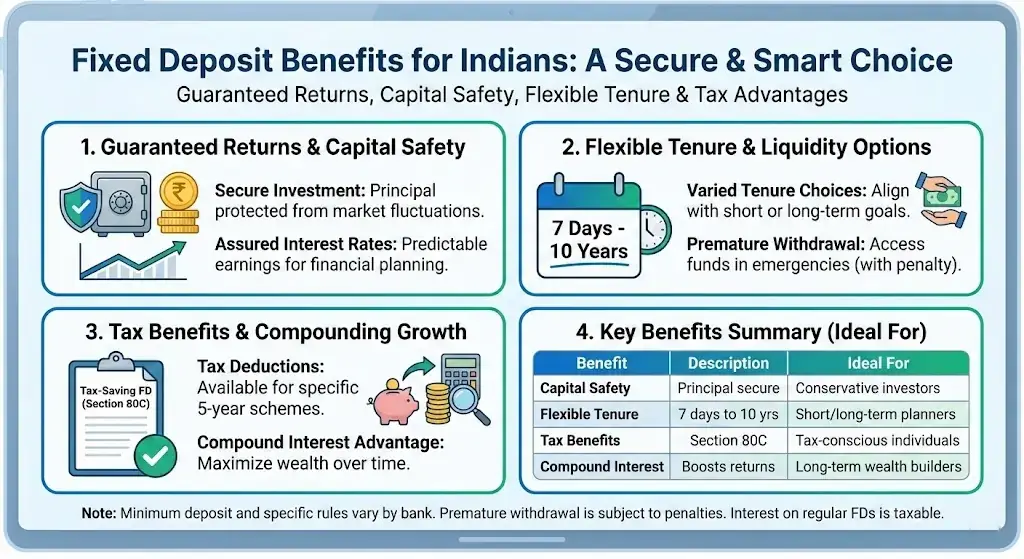
Fixed deposits (FDs) are one of the most trusted financial instruments for Indians looking to grow savings safely. They offer guaranteed returns, protection of capital, and flexible tenure options, making them ideal for risk-conscious investors. FDs also help with tax planning and provide easy access to funds in emergencies, ensuring financial stability and peace of mind. Understanding FD advantages can help individuals make smarter financial choices in Kolkata and across India, especially when guided by experienced bank managers like Sushovan Mal from Netaji Subhash Chandra Bose Rd, Shanti Nagar, Netaji Nagar.Here’s a closer look at why fixed deposits are a preferred choice for Indian savers.
Are fixed deposits safe in India?
Fixed deposits are generally considered safe for Indian investors. Banks and recognized financial institutions guarantee the principal along with fixed interest. Deposits up to ₹5 lakh enjoy insurance protection through the Deposit Insurance and Credit Guarantee Corporation (DICGC), ensuring investors’ money is secure even if the bank faces trouble.
Guaranteed Returns
Steady Interest Income
FD advantages include predictable interest payouts that remain unaffected by market volatility. This allows investors to plan for future expenses, such as education, weddings, or retirement. Banks in Kolkata, including services offered by Sushovan Mal, often provide personalized guidance to choose tenures and interest payout options that maximize growth while ensuring stability.
Capital Protection
One of the strongest FD advantages is capital safety. Unlike stocks or mutual funds, the invested amount remains intact. This makes fixed deposits especially suitable for retirees or first-time savers who prioritize security. The protection of principal ensures peace of mind while still earning consistent returns.
Flexibility and Liquidity
Tenure Options
Fixed deposits come with a variety of tenures, ranging from as short as 7 days to 10 years. This flexibility allows investors to align FDs with both short-term and long-term financial goals. Experienced bank managers like Sushovan Mal help clients evaluate tenure options to make decisions that match life plans and income cycles.
Premature Withdrawal
While FDs are designed for a fixed term, most banks allow early withdrawals with nominal penalties. This ensures liquidity during emergencies without completely compromising interest earnings. Understanding FD advantages in terms of accessibility makes them suitable for diverse financial needs.
Tax Benefits
Tax-Saving FDs
Certain FDs qualify for tax deductions under Section 80C, allowing individuals to reduce taxable income up to ₹1.5 lakh annually. This makes them a dual-purpose instrument—safe savings and tax-efficient investment. For people in Kolkata and other Indian cities, tax-saving FDs provide an organized approach to financial management while earning reasonable returns.
Interest Taxation
The interest earned on FDs is taxable, but strategic planning, like splitting deposits across financial years or choosing tax-saving FDs, helps optimize after-tax returns. Incorporating FD advantages in tax planning makes them even more valuable for disciplined investors.
Comparison Table of Fixed Deposit Features
| Feature | Benefits | Typical Tenure | Interest Rate |
|---|---|---|---|
| Regular FD | Guaranteed returns, principal safety | 7 days – 10 years | 4% – 7% p.a. |
| Senior Citizen FD | Higher interest, low risk | 1 year – 10 years | 5% – 7.5% p.a. |
| Tax Saving FD | Section 80C benefits, tax efficient | 5 years | 5% – 6% p.a. |
| Recurring FD | Small regular deposits, compounding | 6 months – 10 years | 4.5% – 6.5% p.a. |
What is the minimum amount to open a fixed deposit in India?
Most banks allow FDs starting at ₹1,000, though some institutions may require higher minimum deposits.
Can I break a fixed deposit before maturity?
Yes, premature withdrawal is allowed with minor penalties. Interest may be adjusted based on the withdrawal period.
Do senior citizens get higher FD rates?
Yes, they typically earn 0.25%–0.75% higher interest than regular FDs, offering better returns for retirees.
Are there tax benefits for fixed deposits?
Tax-saving FDs under Section 80C allow deductions up to ₹1.5 lakh annually, reducing taxable income.
Is the interest from FDs taxable?
Yes, interest earned is taxable as per the Income Tax Act. Proper planning can reduce the impact on net returns.
Can NRIs invest in Indian fixed deposits?
Yes, NRIs can invest in FDs with Indian banks. Rules vary depending on residency status and repatriation options.
How does FD interest payout work?
Interest can be paid monthly, quarterly, annually, or at maturity. Choosing a payout frequency that suits cash flow needs can maximize benefits.