GK Preparation Strategy for SSC and Railway Exams 2026
20 Jan 2026, 5:48 PM IST
GK Preparation Strategy for SSC and Railway Exams
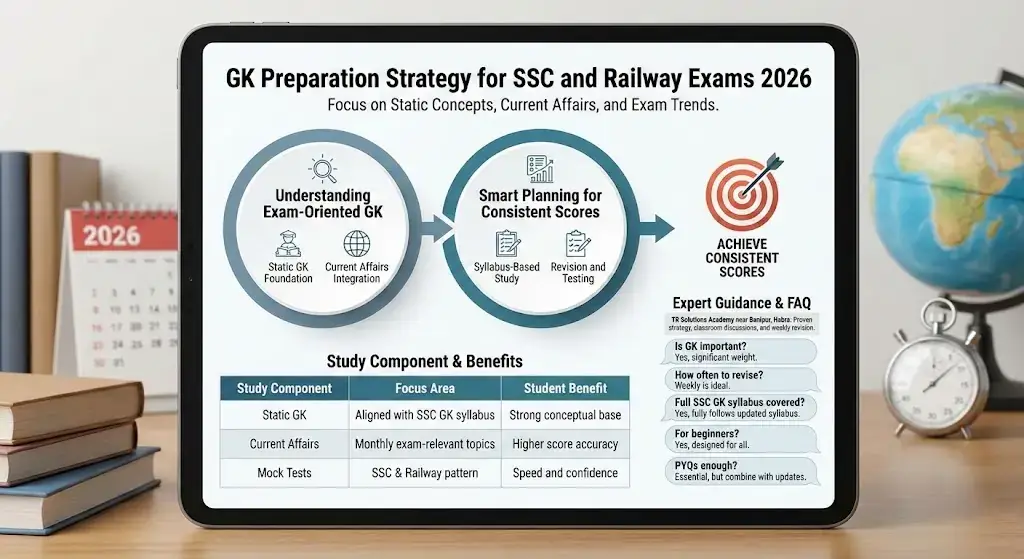
Preparing General Knowledge for SSC and Railway exams is not about memorising random facts. It is about following a clear gk preparation strategy for ssc and railway exams that aligns with the exam pattern, question trends, and time pressure. At TR Solutions Academy in Banipur, Habra, West Bengal, GK preparation is treated as a scoring weapon, not a risky section. With the right planning, even average students can score consistently high marks.A focused approach built around the ssc gk syllabus, regular revision, and exam-oriented practice gives aspirants a strong edge in SSC CGL, CHSL, MTS, GD, and Railway NTPC or Group D exams.
Why GK Decides Selection in SSC and Railway Exams
General Knowledge often becomes the deciding factor in final merit. Maths and Reasoning require calculation time, but GK answers are instant. One correct GK response takes seconds. One wrong fact costs marks.This is why a structured gk preparation strategy for ssc and railway exams is essential.
The SSC GK syllabus and Railway GK sections repeatedly ask from predictable areas:
- History and Geography basics
- Indian Polity concepts
- General Science fundamentals
- Current affairs with static linkage
Understanding the SSC GK Syllabus First
What the SSC GK Syllabus Actually Includes
Before opening any book, aspirants must clearly understand the ssc gk syllabus. At TR Solutions Academy, GK classes always begin with syllabus mapping, not guessing.The syllabus broadly covers:
- History: Ancient, Medieval, Modern India
- Geography: India and World basics
- Indian Polity and Constitution
- Indian Economy (basic concepts)
- General Science (Physics, Chemistry, Biology)
- Current Affairs (last 6–12 months)
Why Syllabus-Based Study Saves Time
Many aspirants read GK books cover to cover. That approach fails. A syllabus-driven gk preparation strategy for ssc and railway exams keeps preparation sharp, limited, and effective.Smart GK Preparation Strategy for SSC and Railway Exams
Build Static GK Before Current Affairs
Static GK forms the base. Without understanding history timelines or science basics, current affairs feel confusing. At our academy in Banipur, static GK is taught first, slowly and clearly.Once the base is ready, current affairs become easier to remember.
Link Facts With Context
Rote learning breaks quickly. Context stays longer. For example, instead of memorising dates alone, understanding why events happened improves recall during exams.This method is central to our gk preparation strategy for ssc and railway exams.
Daily and Weekly GK Study Routine That Works
Daily GK Practice
Students are advised to study GK in short but focused sessions. Long hours reduce retention. Short, repeated exposure improves memory.Ideal daily plan:
- 30–40 minutes static GK
- 20 minutes current affairs
- 10 minutes quick revision
Weekly Revision Method
Revision is where selection happens. Every week, one full revision cycle is mandatory. At TR Solutions Academy, weekly tests are conducted strictly as per SSC and Railway patterns.This routine strengthens the ssc gk syllabus coverage without stress.
Role of Coaching in GK Preparation
Self-study is important. Direction is critical. Without guidance, students often study unnecessary topics.At TR Solutions Academy, near Banipur, Habra:
- GK is taught with exam logic
- Topics are filtered strictly by syllabus
- Doubts are cleared instantly
- Previous year questions are discussed in class
Mobile-Responsive Comparison Table: Smart GK Study Approach
(Table uses predefined Bootstrap classes)Common GK Mistakes Aspirants Must Avoid
Many students fail not due to lack of effort, but due to wrong methods.Avoid these mistakes:
- Ignoring the SSC GK syllabus
- Studying only current affairs
- Skipping revision
- Avoiding previous year questions
Why TR Solutions Academy Is Trusted for GK Preparation
Located near Banipur, Habra, West Bengal, TR Solutions Academy focuses on results, not volume. GK classes are:- Exam-oriented
- Easy to understand
- Continuously updated
- Backed by practice tests